The Cost of Code Is Not Heading to Zero — It’s About to Get Expensive

Published on
–
7
min read
You have probably seen the headlines. The cost of code is heading towards zero. AI will write all the code. Developers are optional. It is a compelling narrative, and it is coming from people with serious influence.
Andreessen Horowitz general partner Martin Casado has made the theoretical case in published essays, arguing that just as the microchip brought the marginal cost of computation to zero, and the internet brought the marginal cost of distribution to zero, generative AI will do the same for the cost of creation. OpenAI CEO Sam Altman has publicly claimed that the cost of using AI at a given capability level falls by a factor of 10 every 12 months. Anthropic’s own CEO Dario Amodei predicted in early 2025 that AI would be writing essentially all code within three to six months, and a recent Forbes piece framed it as the last competitive advantage in software no longer being software itself.
I think this is misleading and, in some cases, dangerously wrong. Not because AI coding tools are not impressive (they are), but because the “cost heading to zero” claim mistakes the current price you are paying for the actual cost of what is being provided. Those are two very different things, and the gap between them is being filled by billions of dollars in venture capital that will not last forever.
What You Are Actually Paying For Right Now
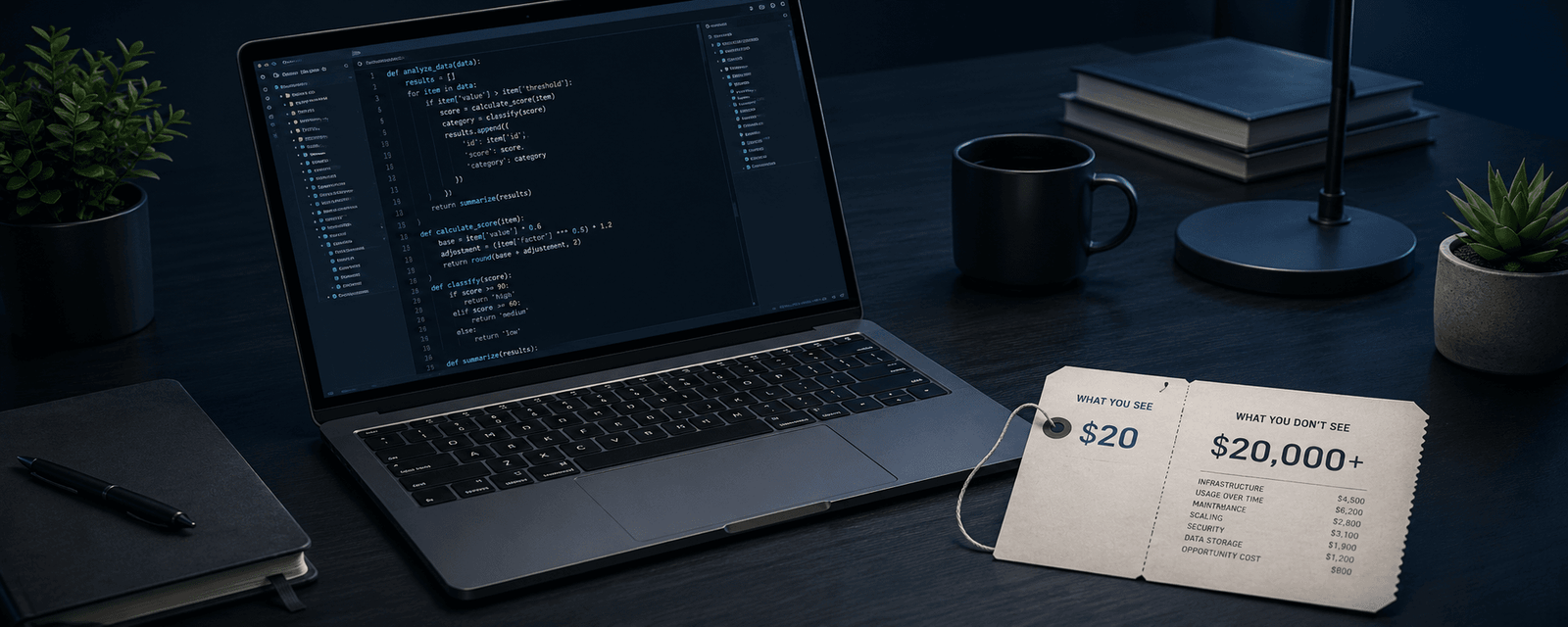
When you sign up for Claude Code at $20 a month, or Cursor at a similar price , you are not paying the real cost of what you are consuming. You are paying a subsidised introductory rate. The real price comes later.
According to Anthropic’s own Claude Code documentation, as cited by Steve Smith at Ardalis, the average developer cost to serve is around $6 per day, which comes to roughly $180 per month. The Max plan is priced at $100 to $200 per month. At moderate usage, that subscription does not cover the compute cost of running it. An independent analysis found that a user on Anthropic’s $20 per month plan can incur up to $163 in actual compute costs in a single month. One developer reportedly generated nearly $600 in additional API charges from just an hour or two of overrun on a single project.
The companies providing these tools are not yet making money on them. According to financial documents reported by the Wall Street Journal, OpenAI is projected to lose $14 billion in 2026 and expects to burn through $17 billion in cash this year, against full-year 2025 revenue of around $13 billion, though its annualised run-rate has since grown significantly. Anthropic is burning cash at a similar pace relative to revenue, with losses estimated at around $11 billion for 2026 as it pushes towards a profitability target of 2027 to 2028.
The scale of outside investment propping this up is striking. Google, Amazon, and Microsoft have between them committed hundreds of billions in planned AI-related infrastructure spending. Amazon has invested an estimated $15 billion or more into keeping Anthropic operational, most of which cycles back as AWS compute spend. These are not the economics of a service that has found its market price. This is a land grab, deliberately priced below cost.
The Uber analogy is apt here. In the early years, Uber rides felt implausibly cheap, because they were. Subsidised by venture capital to capture the market, the pricing was never sustainable. Once Uber had embedded itself into enough daily routines, prices adjusted to something closer to economic reality. AI coding tools are in exactly that phase right now. The price you are paying today is the loss-leader price, not the long-term price.
The Pricing Squeeze Is Already Starting
This is not a theoretical future concern. The adjustments are already happening, quietly.
In March 2026, Anthropic reduced usage limits for Claude during peak hours, noting that around 7% of users would hit session limits they hadn’t before. In the same period, Anthropic announced that Claude Code usage for enterprise accounts would shift from a per-seat fee to per-token billing. One observer summed it up well: “The subscription was an open bar.”
In April 2026, Anthropic briefly tested gating Claude Code access to the Max plan only, which would have raised the entry price from $20 to $100 per month, before reversing the change after significant community backlash. The test was real, even if the rollout was not.
Developers using Claude Code have also reported a software bug introduced in version 2.1.100 that inflated token consumption by around 40 per cent, with some users finding their Max 20x plans exhausted within 70 minutes of the monthly reset. Community members reverse-engineered the binary and found caching bugs that inflated costs by 10 to 20 times in some cases. Anthropic acknowledged the issue, but if you missed a deadline because your $200 a month tool stopped working mid-project, an acknowledgement does not help.
At the enterprise level, the direction of travel is clear even if precise figures are hard to pin down. One analyst tracking AI contract structures has noted a significant upward shift in minimum annual contract values, from around $50,000 to typically $200,000 or more. Whether or not those exact numbers hold across the market, the broader pattern is consistent: what was previously offered as a volume discount is increasingly framed as “price protection”, meaning you pay today’s rate even as costs rise, which is not a discount at all.
The Technical Debt Bill Is Coming
Even if API token prices continued to fall and competition from models like DeepSeek V4 Pro puts genuine pressure on Western providers, that would only address one part of the real cost of AI-driven development. The less visible part is what happens after the code ships.
The research is detailed on this. A 2026 analysis of 8.1 million pull requests from 4,800 development teams found that AI-generated code contains 1.7 times more issues than human-written code, and that technical debt increases between 30 and 41 per cent after AI tool adoption. Despite developers feeling faster, end-to-end delivery was measured as 19 per cent slower once the full workflow was accounted for. Pull requests per developer increased by 20 per cent, but incidents per pull request jumped by 23.5 per cent.
MIT Sloan Management Review found that while AI tools can boost short-term productivity by up to 55 per cent, rapid deployment creates dangerous technical debt, particularly in existing codebases where AI-generated code compounds existing problems. Forrester projects that 75 per cent of technology decision-makers will face moderate-to-severe debt levels in 2026, driven largely by AI-assisted development. Gartner goes further, projecting that prompt-to-app approaches will increase software defects by 2,500 per cent by 2028.
The longer-term maintenance picture is just as concerning. Unmanaged AI-generated code can drive maintenance costs to four times traditional levels by year two as technical debt compounds. GitClear’s analysis of over 211 million changed lines of code found a 60 per cent decline in refactored code as teams prioritise velocity over codebase health. The code ships faster, but the cost of keeping it running, secure, and maintainable increases proportionally.
In other words, even if the cost of writing the code itself fell, the cost of everything that follows is rising: maintenance, security remediation, review overhead, rework, and incident response. Organisations that are not factoring these into their AI development spend are doing incomplete accounting.
To Be Fair to the Other Side
It is worth noting that the Medium post that partly prompted this includes a version of this argument. The author notes that companies which simply gut their R&D budget to fund an “AI budget 2027” are heading for failure, and that this transition requires adding budget, not reshuffling it. That is a reasonable position, and I agree with it. The headline claim that the cost of code has dropped to zero is what I take issue with, not the nuanced argument underneath it.
The cost of generating a line of code may be approaching negligible levels. The cost of building reliable, maintainable, secure software is not. The cost of the tools needed to generate that code at scale, once the subsidies end, will not be negligible either.
What I Think Happens Next
My expectation is that AI development costs will increase significantly for most companies over the next three to five years. There are three reasons I keep coming back to.
The first is that the subsidised pricing period will end. Anthropic projects reaching profitability by 2028, which means transitioning from burning investor money on cheap access to charging what the service actually costs. OpenAI’s path to the same destination is longer and more expensive. Either way, the pricing normalises upward, not downward. The companies providing these tools are not charities, and their investors are not either.
The second is that usage will grow faster than efficiency gains. Agentic coding workflows, where an AI model works autonomously for hours on a codebase, consume enormous numbers of tokens. The average cost today is around $6 per developer per day, but teams running multi-agent workflows are already seeing that figure multiply. As capabilities improve and adoption deepens, token consumption grows. A lower per-token cost does not mean a lower overall cost when you are using ten times as many.
The third is that the technical debt will come due. Companies that have spent 2024 and 2025 shipping AI-generated code at speed will spend 2026 and beyond paying for the quality deficit. That cost is real and largely invisible until it arrives as slower delivery, higher defect rates, or a significant incident that forces an expensive rewrite.
The Practical Stance
None of this means AI coding tools are not worth using. They offer genuine productivity gains, and I use them myself ( How I Built a WordPress Block Theme Using Google Stitch, Claude Code, and WordPress Studio ). But the decision to depend on them deeply, structurally, across an engineering team, at scale, should be made with eyes open to the full cost picture, not just what the headline subscription price says today.
The cost of software is not heading to zero. The cost of generating code quickly is temporarily subsidised to near zero to capture your workflow and data. Those are two very different things, and the difference will become very clear once the investor capital underwriting this period of cheap access starts looking for a return.
AI companies are running the oldest playbook in the technology industry. Get the product in front of you cheaply, make it genuinely useful, wait until it is embedded in your daily workflow, and then adjust the price once switching is painful. Printer manufacturers perfected this with cheap hardware and expensive ink cartridges. Cloud storage providers did it with generous free tiers that quietly became indispensable. AI coding tools are doing the same thing, just at a much larger scale and with a much greater dependence on the other end.
The risk of outage is also rarely discussed. If you restructure your engineering team around Claude Code or Cursor and one of those services goes down, your coding productivity does not slow down. It stops. Completely. You have traded the resilience of an in-house team for a dependency on a third-party service that is currently running at a loss and will eventually need to charge you what it actually costs. That is not necessarily the wrong trade-off, but it is a trade-off worth understanding before you make it.
If you are a CTO, a development lead, or someone responsible for technology budgets, my practical advice is this: do not base your cost structure on today’s pricing. Build for what this would cost at market rate, factor in the maintenance overhead the research already documents, and treat the current pricing as the introductory offer it almost certainly is.
The financial documents, the pricing adjustments already underway, and the technical debt data all point in the same direction. I am happy to be wrong. But I would not be planning around it.
Leave a Reply