
Every time Anthropic releases a new model, social media does what it always does. Within hours, X and LinkedIn are full of posts claiming it is the most capable AI ever built. Threads appear titled “10 insane things I built with Claude Fable 5 in one hour.” Developers share screenshots of complex code that appears out of nowhere. Founders declare that their entire workflow has changed overnight.
Claude Fable 5 launched on 9 June 2026, and the hype has been running at full speed ever since. The benchmarks are real, and some of what people are building with it is remarkable. But the noise around every new model release drowns out the one question that actually matters for most organisations using AI day-to-day: is this model the right tool for what my team is actually doing, and does Claude Fable 5 pricing make sense for the work we actually do?
In the case of Fable 5, the answer is sitting right there in the numbers. It costs exactly twice as much as Opus 4.8. Whether it is twice as good depends entirely on the task, and for most of what teams are actually doing with AI, it is not. Anthropic’s full model range currently spans Fable 5, Opus 4.8, Sonnet 4.6, and Haiku 4.5, and any honest Claude model comparison shows that the differences between them matter far more than the hype at the top end suggests.
Claude Fable 5 Pricing: What You Are Actually Paying
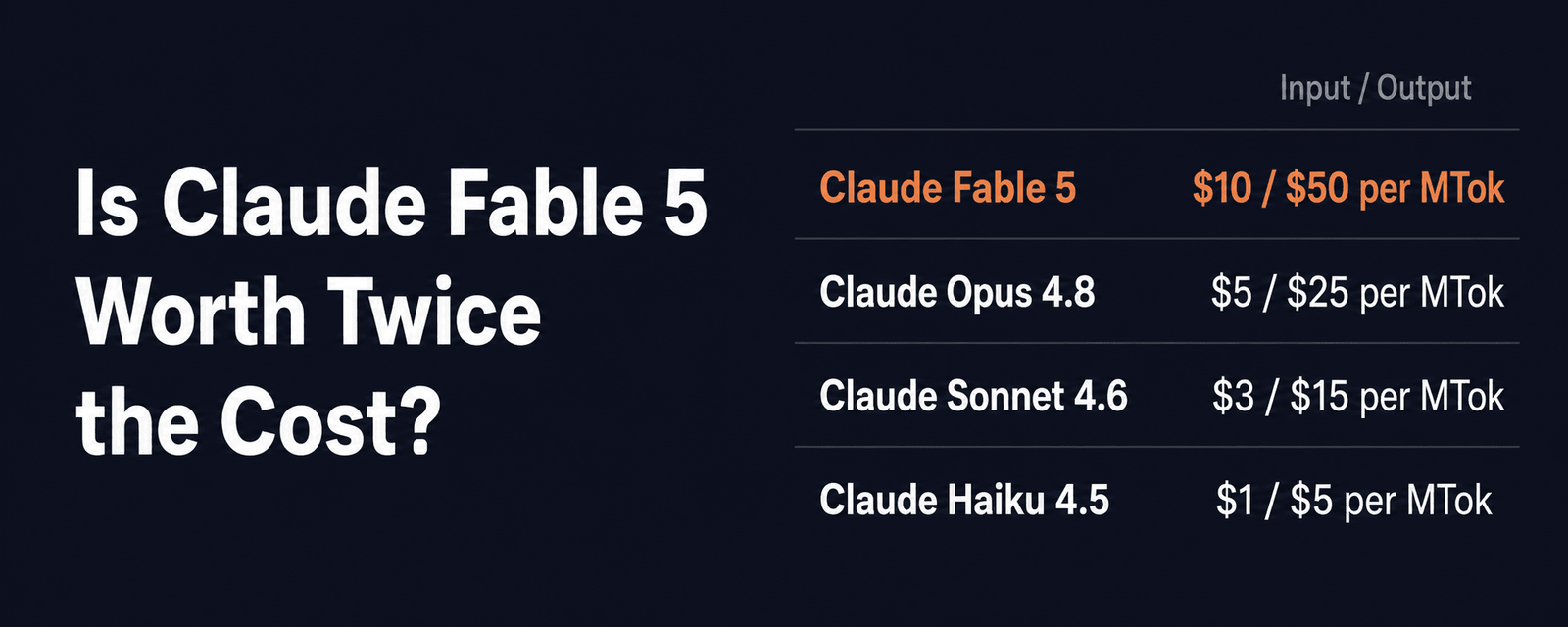
According to Anthropic’s official API pricing page, the full current model range breaks down like this:
- Claude Fable 5: $10 per million input tokens / $50 per million output tokens
- Claude Opus 4.8: $5 per million input tokens / $25 per million output tokens
- Claude Sonnet 4.6: $3 per million input tokens / $15 per million output tokens
- Claude Haiku 4.5: $1 per million input tokens / $5 per million output tokens
Switch everything from Opus 4.8 to Fable 5 and your API bill doubles. Switch from Sonnet 4.6 and it more than triples. Haiku 4.5, which handles plenty of production workloads quietly and competently, costs a tenth of what Fable 5 charges on output tokens.
None of this is hidden. The pricing page is publicly available. It just does not feature prominently in the viral posts.
Where Fable 5 Is Genuinely Better
Fable 5 does outperform Opus 4.8 on the tasks it was designed for. According to benchmarks published by BenchLM and cross-referenced with Anthropic’s own launch data, Fable 5 scores 80.3% on SWE-Bench Pro against Opus 4.8’s 69.2%, with roughly double the gap on FrontierCode. On general benchmark leaderboards, Fable 5 comes in at around 96, compared to Opus 4.8’s 94.
Anthropic’s framing at launch was deliberate: “the longer and more complex the task, the larger Fable 5’s lead.” That sentence is the most useful thing they said. It tells you exactly where the extra cost is justified: long-running agentic coding, large-codebase migrations, multi-step research tasks where the model has to retain a lot of context and make a series of decisions that depend on one another.
The independent evaluation published by The Every Company puts some numbers on this. They used the same Senior Engineer benchmark given to human candidates in their hiring process. Fable 5 scored 91 out of 100. Opus 4.8 scored 63. That is a 45% absolute gap on a test built to challenge experienced engineers. On genuinely hard engineering work, Fable 5 earns its price.
Early real-world results back this up. Stripe reportedly used Fable 5 to complete a migration across a 50-million-line codebase in a single day, work that a full team would have needed over two months to finish by hand. That is exactly the kind of task Fable 5 was built for.
Where the Gap Largely Disappears
For short, everyday tasks — summarising a document, drafting an email, answering a research question, reviewing a small block of code — the performance difference between Fable 5 and Opus 4.8 is in practice very hard to detect. INCLAW’s June 2026 comparison is straightforward about it: on short, well-defined tasks both models are excellent, and you would struggle to tell them apart. The gap shows up on the long, complex stuff, not the everyday work.
TrueFoundry’s analysis puts the practical case plainly: Opus 4.8 is the better default for most everyday work in terms of cost and speed. Use Fable 5 for the hard jobs and Opus 4.8 for the rest. Anthropic’s own model selection guidance on claude.com says the same thing. Fable 5 “uses the most of your rate limit” and is positioned for your “largest, most important projects,” not your everyday assistant.
There is also something in the technical detail worth knowing about. Fable 5 ships with safety classifiers covering cybersecurity, biology, chemistry, and certain distillation tasks. When a request triggers one of those classifiers, the model routes the query to a Claude Opus 4.8 fallback and answers from there. As llm-stats.com’s breakdown explains, in those domains, the best-case is an Opus 4.8 answer, so paying the Fable 5 premium gets you nothing.
You are paying twice as much for the same output you would have received by calling Opus 4.8 directly. Anthropic has been transparent about this behaviour, and it is a reasonable safety decision. It is also the kind of detail that does not appear in the “10 insane things” posts.
Most Teams Are Not Running 50 Million Line Migrations
The Stripe example is striking, but it is not how most businesses and teams are actually using AI.
Most organisations using Claude via the API or Claude.ai are using it for drafting communications, summarising documents, reviewing written content, assisting with customer support responses, generating code for well-scoped tasks, and assisting with research. Genuinely useful work, but not multi-hour autonomous coding sessions. For most of it, Opus 4.8 or Sonnet 4.6 is more than capable and the Fable 5 premium returns nothing you would actually notice.
The Tygart Media model comparison, published a week after launch, is direct about it: for the vast majority of real-world tasks, Sonnet’s output is indistinguishable from Opus at a fraction of the cost. Multiple comparisons published since the Fable 5 launch reach the same conclusion. Use Sonnet 4.6 for around 80% of daily work, including emails, summaries, and content. Reserve Fable 5 for long, complex tasks where you cannot easily check the output yourself. Keep Opus 4.8 as the sensible default for the harder work that sits between those two ends.
The ROI Question Nobody Is Asking
The model selection problem does not sit in isolation. It connects to a broader question about what organisations are actually getting back from their AI spending, and the data on that makes for uncomfortable reading.
A Forbes research survey from 2025, covering hundreds of executives, found that fewer than 1% reported significant ROI from their AI investments, despite CEO involvement in AI decision-making roughly doubling in the same period. MIT research published in 2026 found that 95% of generative AI pilots delivered no measurable profit-and-loss impact. S&P Global found that 42% of companies abandoned most of their AI projects in 2025. Morgan Stanley found that only 21% of S&P 500 companies could point to a measurable AI benefit.
According to reporting from The AI Consulting Network, average enterprise AI spend is projected to jump from around $7 million per company in 2025 to $11.6 million in 2026. The money is going in. The returns are not coming back out at anything close to the same rate.
There are plenty of reasons for that gap: poor governance, disconnected metrics, lack of training, no clear ownership of outcomes. But part of the problem is almost certainly that organisations are not being thoughtful about which model they are using for which task. If a team defaults to the most expensive model because it launched recently and got good write-ups on social media, then uses it to draft emails and summarise meeting notes, they are burning budget on capability they are not using. Scaled across a company, that is a real and largely invisible cost.
As the Terminal X analysis puts it: the companies pulling ahead are not buying better models. They built measurement, infrastructure, and strategy underneath the technology before deploying it. The model choice is almost the last decision, not the first.
Token Costs Compound Faster Than the Pricing Page Suggests
Even setting Fable 5 aside, token costs deserve more attention than most teams give them. I wrote about this in detail in my post on reducing token usage in Claude Code and Codex, but the short version is this: the most expensive thing in an AI coding session is usually not a single large prompt. It is the steady build-up of context that gets reprocessed on every single turn: every file read, every tool output, all of the conversation history up to that point.
According to Anthropic’s documentation, average enterprise Claude Code usage runs around $150 to $250 per developer per month. Developers running agentic workflows across large codebases can find themselves at $500 to $2,000 a month or more via the API. Choosing the right model for each task is one of the biggest levers in controlling that cost. As noted in Claude Code’s model selection documentation, switching models by task complexity rather than defaulting to the most powerful option can reduce overall API costs by 60 to 80% with no noticeable drop in output quality for most workloads.
The annualised numbers show why this matters. A team running 10 million output tokens a month pays:
- $600,000 a year on Fable 5
- $300,000 a year on Opus 4.8
- $180,000 a year on Sonnet 4.6
Getting the model selection right is not a minor optimisation. For any team using AI at scale, the cost structure is key.
Is Fable 5 Worth Twice the Cost?
Sometimes. On the right tasks it can be worth more than twice the cost. On the wrong tasks, you are paying twice as much for output you could not distinguish from what Opus 4.8 or Sonnet 4.6 would have produced.
Asking whether Fable 5 is the best model is the wrong question. The right question is whether the model you are using matches the complexity and stakes of what you are actually doing.
- Fable 5 earns its price on large, multi-step, autonomous tasks where the model needs to plan, hold context across many steps, check its own work, and complete something that would take a skilled human several hours.
- Opus 4.8 is the better default for complex reasoning that does not hit that bar, and it is what Fable 5 itself falls back to in restricted domains.
- Sonnet 4.6 handles most everyday production workloads well at a fraction of the cost.
- Haiku 4.5 is the right choice for fast, high-volume tasks where deep reasoning is unnecessary.
The hype around each new model release pushes a single message: upgrade. The people posting the impressive demos are usually the ones who found the specific, hard problems where the new model genuinely stands out. That is worth knowing about, but it is not most people’s day-to-day reality.
Fable 5 is free on paid Claude plans until 22 June 2026. Use that window to test it against Opus 4.8 on your actual tasks, not the ones from the viral posts. That is a more useful Claude model comparison than any benchmark table: your real workload, your real outputs, your real costs. You might find the upgrade is worth it for a specific part of your workflow. You might find that Sonnet 4.6 was doing the job perfectly well all along, at a third of the price.
If you want a clearer picture of where your token spend is actually going before adding a more expensive model to the mix, my post on reducing token usage in Claude Code and Codex covers the practical steps. Understanding your costs before choosing your model is a more useful exercise than switching defaults because someone on LinkedIn had a good morning with a codebase migration.
As I wrote when covering why AI code costs are not heading to zero, the real costs of AI-assisted work are rarely what the pricing page suggests.
All pricing figures are taken from Anthropic’s official API pricing page and were correct at the time of writing in June 2026.
Leave a Reply