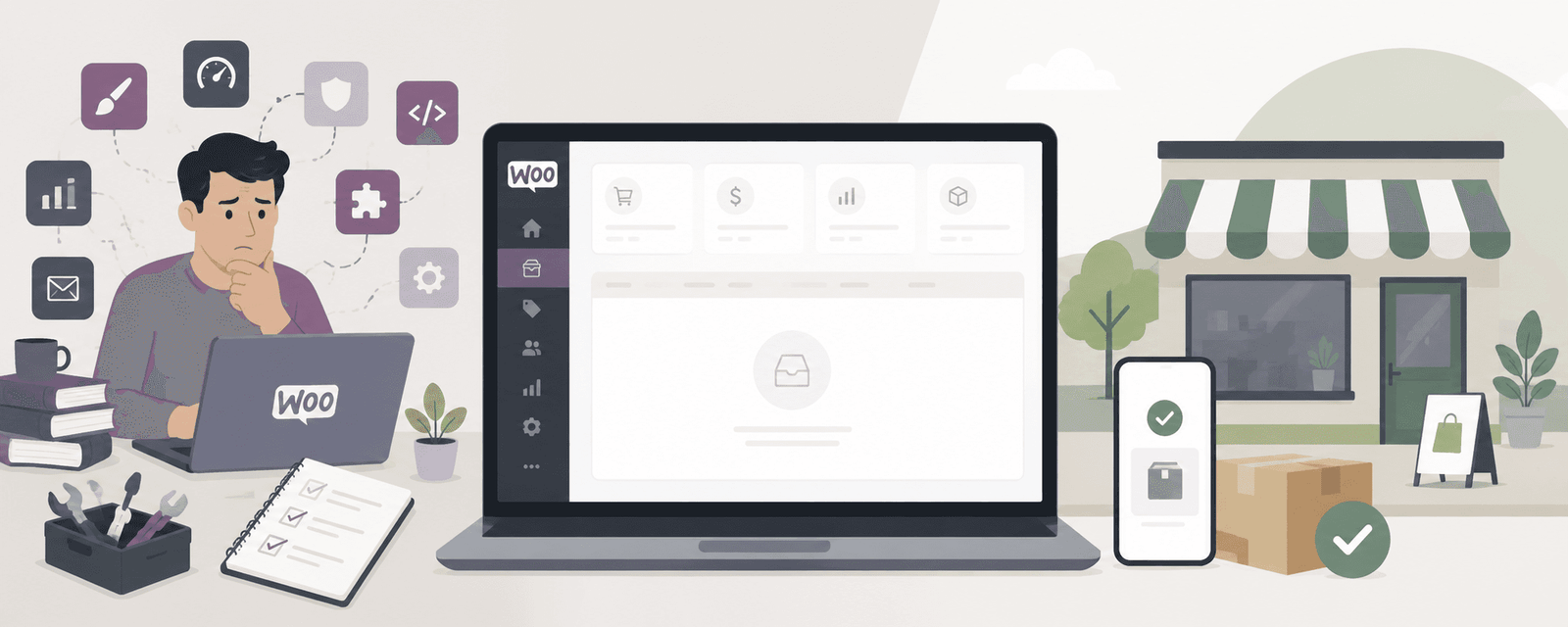

If your WooCommerce store is not selling, the most likely reason is not a missing feature. I have lost count of the number of store owners I have spoken to who are months into building and still have not made a single sale. Not because their product is bad. Not because the market does not exist. But because they are still building.
There is always something left to do. The navigation menu needs refining. The product photography could be better. They have not added that loyalty points plugin yet. The homepage banner is not quite right. And so the launch date slides, the weeks pass, and the products sit in draft.
This post is about why that happens, why it is so common, and what to actually prioritise before you open your WooCommerce store for business.
The Perfectionism Trap
Building feels like progress. There is always a task to check off, a setting to configure, a plugin to evaluate. It is busy work that creates the sensation of moving forward without the risk of actually going to market.
Launching is different. Launching means putting something in front of real people and finding out whether they want it. That introduces the possibility of rejection, silence, or negative feedback, and many new store owners find ways to delay that moment for as long as possible.
This is not laziness. Research published on Entrepreneur.com describes the pattern clearly: fear of failure is often the root cause of procrastination in high performers, with perfectionism creating the illusion of productivity while avoiding meaningful progress. Psychologist Joseph Ferrari has studied this in entrepreneurs specifically. He found that “avoiders”, people who delay action out of fear, would rather others think they lack effort than ability. Adding another feature is a way of not finding out whether the product will actually sell.
No amount of additional features removes that risk. The store can always be more polished. There will always be something else to add. Every week spent in preparation is a week without revenue, without real customer feedback, and without any actual signal that your WooCommerce store will sell.
Product Orientation: Falling in Love With the Store Instead of the Customer
There is a concept in marketing called product orientation, which is the tendency for a business owner to become so absorbed in what they are building that they lose sight of what their customers actually need.
It is easy to see how this happens with a WooCommerce store. You have spent hours choosing a theme, configuring payment gateways, setting up shipping zones, and writing product descriptions. The store feels like yours. It is natural to want it to reflect your standards before anyone else sees it.
But here is the problem: your customer does not care about most of that. What they care about is whether your product solves their problem, saves them time, or gives them something they want. That is what will determine whether your WooCommerce store makes sales, not the features behind it.
Shopify’s own analysis of common ecommerce mistakes makes this point directly: without audience insights, businesses end up prioritising their own goals over consumer needs, focusing on launching features that customers were never asking for rather than improving the parts of the experience customers actually use.
The feature you have spent three weeks researching is almost certainly not the thing standing between you and your first sale. A clear product description and a working checkout are far more likely to be.
The Checklist Trap and Decision Fatigue
A related mistake is the belief that more is always better: more products, more filters, more options, more payment methods, more navigation links. The instinct is understandable. More choice feels like better service.
In reality, the opposite is often true. According to a 2024 Forrester survey cited in research on choice overload, nearly 40% of consumers had abandoned an online cart in the past month specifically because of overwhelming product options. The psychology behind this is well established. Columbia University professor Sheena Iyengar’s research on choice overload consistently found that presenting customers with more options reduces satisfaction, increases regret, and decreases the likelihood of purchasing at all. The average cart abandonment rate across ecommerce as a whole is already around 70%. Overloading customers with options pushes that number higher.
For a new store, the practical lesson is straightforward: start with a focused product range. Launch with the products you are most confident in, not everything you could possibly offer. You can always expand once you have real data to guide you.
Why a Polished Store Without Marketing Will Not Sell
Here is the part that many new WooCommerce owners miss entirely: a website, however polished, does not generate sales by itself. If your WooCommerce store is not selling, traffic is almost always part of the reason. It does not just arrive because the store is ready. And yet, in my experience, a huge proportion of the time and money spent before launch goes into building the store, and almost none of it goes into thinking about how customers will actually find it.
Research into ecommerce failure rates consistently points to weak marketing strategy, not missing features, as one of the primary causes of early failure. One analysis put it plainly: throwing the entire budget into products, photography, and the ecommerce platform itself without leaving money for marketing is a straightforward path to zero sales. Most stores that fail in the first six months do so because of poor marketing planning and an inability to acquire customers profitably, rather than because of missing features.
A simple WooCommerce store with a clear product page and a genuine effort to put it in front of the right people will outsell a beautifully engineered store that nobody knows exists.
What WooCommerce Already Gives You Out of the Box
Many new store owners genuinely underestimate how much WooCommerce provides before a single plugin is added. Out of the box, you get:
- Product listings and variable products
- A shopping cart and checkout
- Multiple payment gateway options
- Basic coupon support
- Order management and customer accounts
- Automated email notifications
- Tax configuration
That is a functional online store. It is enough to take money from customers today.
You do not need a loyalty programme before you have any loyal customers. You do not need a wishlists plugin before you know whether people want to save your products. You do not need a subscription option before you know whether people will buy from you once. These are features you build for a store that is already working, based on evidence from customers who are already there.
Launch First and Learn From Real Customers
The most useful framework I have come across for thinking about this is the lean startup methodology, originally set out by Eric Ries. The core idea is straightforward: identify the problem you are solving, build the simplest version of your product that lets you test it, get it in front of customers, and learn from their actual behaviour rather than your assumptions.
The classic example is Zappos. Nick Swinmurn, the founder, wanted to test whether customers would buy shoes online. Rather than building a full warehouse and website, he photographed shoes in local shops, posted the pictures online, and only bought and shipped them after a real customer placed an order. This minimum viable product approach validated demand before he committed significant resources. Zappos eventually became a billion-dollar business built on a model he tested for almost nothing.
The principle applies directly to a WooCommerce store. You do not need to know whether your loyalty programme will work. You do not need to know whether customers prefer a filtered product grid or a simple list. You need to know whether anyone wants to buy what you are selling. If your WooCommerce store is not making sales yet, the only way to find that out is to open it and see.
Real customers will tell you more in two weeks of trading than six months of planning ever could. They will show you which products get attention and which get ignored, where people drop off in the checkout, what questions they ask before buying, and what stops them from coming back. That information cannot be designed in advance. It has to be earned.
What to Actually Focus On Before Launch
None of this means launching a broken or embarrassing store. There are things that genuinely matter before you open for business. In my view, they come down to five basics.
Clear product descriptions that explain benefits, not just features. Customers do not buy specifications. They buy outcomes. Research into why stores with traffic still fail to convert points to the same issue repeatedly: visitors leave because the page does not answer “what problem does this solve for me?” quickly enough. Write your descriptions with that question in front of you.
Decent product photography. Not professional studio work necessarily, but clear, honest images that show what the product actually looks like. Poor photography is one of the most consistent conversion killers in ecommerce.
A working, friction-free checkout. Test it yourself before you launch. Place a real order. Make sure the confirmation email arrives and the payment processes correctly. Long or confusing checkouts drive around 22% of abandonment, and that is before any other problems come into play. Once you are trading, it is also worth setting up an automated abandoned cart recovery sequence to recapture customers who drop off at checkout. I wrote a guide to doing this with AutomateWoo if you want somewhere to start.
A basic plan for getting traffic. Even if it is just telling people on social media, emailing your existing contacts, or posting in a relevant Facebook group. The store needs visitors before it can have customers, and that will not happen on its own.
A way for people to contact you. A simple contact form or email address. Customers who are almost ready to buy often have one question standing in the way. Make it easy for them to ask.
That is a launchable WooCommerce store. Everything else can come later, built on evidence from the people who have actually bought from you.
The Store Does Not Need to Be Perfect. It Needs to Be Open.
If your WooCommerce store is not selling, the features you are agonising over are unlikely to be why. What makes or breaks it is whether the right people know it exists, whether they trust it enough to buy, and whether what you are selling is something they actually want.
You will not find the answer to any of those questions while the store is still in draft. The only thing that generates real information about your customers is trading with them.
Launch with the basics. Watch what happens. Fix what is broken. Add what is asked for. That is how stores improve, not in isolation, but in response to the people using them.
If you have been caught in this trap yourself, months of building with no sales to show for it, I would be interested to hear what finally broke the cycle. Leave a comment below.
Leave a Reply